Artificial Intelligence (AI) is rapidly transforming industries, but many businesses still confuse AI with traditional automation. While both improve efficiency and reduce manual work, they operate very differently and deliver different levels of business impact.
Understanding the difference between AI and traditional automation is critical for companies planning their digital transformation journey.
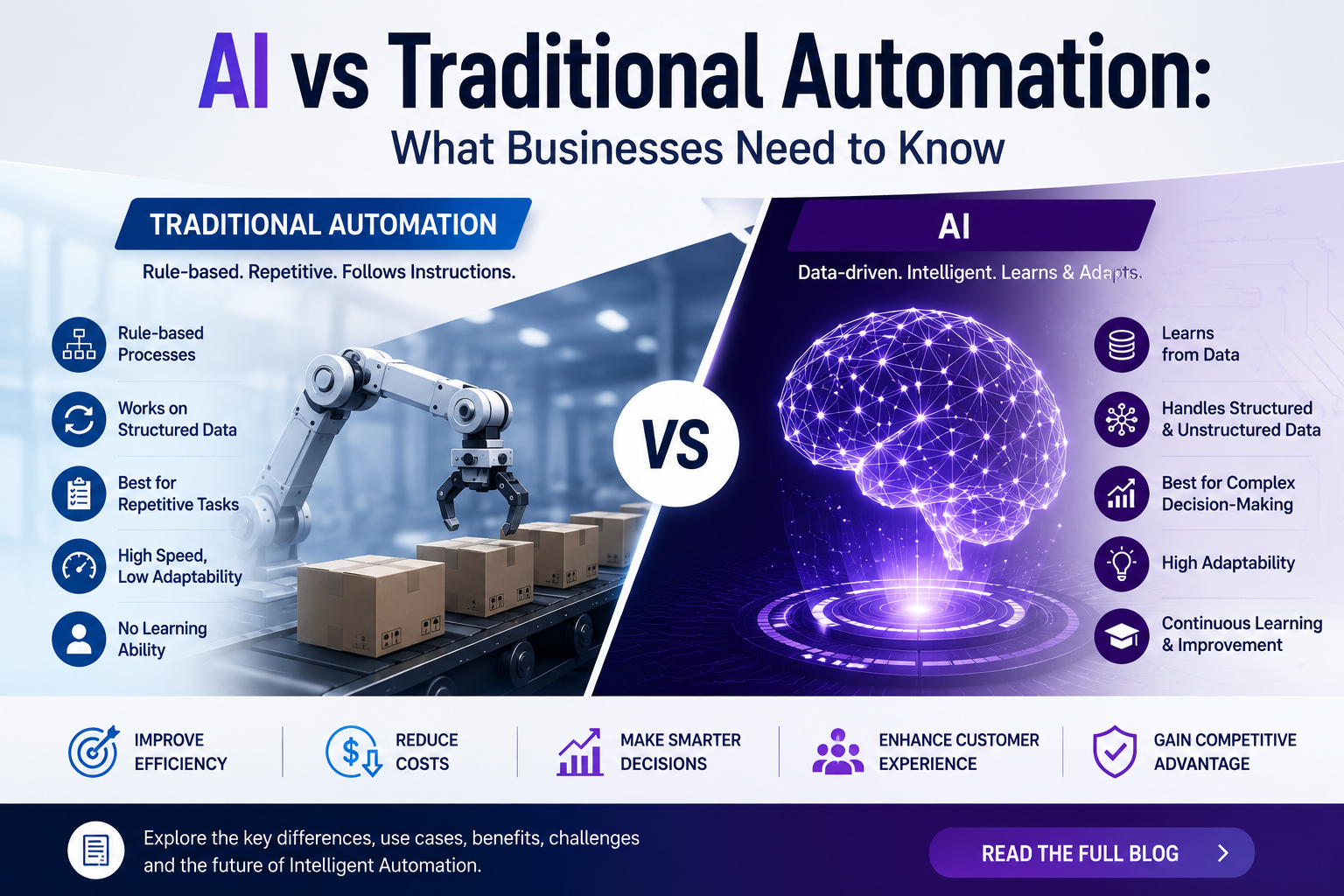
Traditional automation refers to rule-based systems designed to perform repetitive tasks with predefined instructions. These systems follow “if-this-then-that” logic and work best in predictable environments.
Examples include:
1. Automated email workflows
2. Payroll processing systems
3. CRM notifications
4. Manufacturing assembly line automation
5. Data entry bots
Traditional automation is highly effective for repetitive and structured tasks where outcomes remain consistent.
Key Characteristics of Traditional Automation
1.Rule-based operations
2.Requires predefined instructions
3.Limited adaptability Best for repetitive tasks
4. Faster execution with minimal decision-making
What is Artificial Intelligence (AI)?
AI goes beyond predefined rules. It enables systems to learn from data, identify patterns, make decisions, and improve over time.
Unlike traditional automation, AI can handle unstructured data, adapt to changing conditions, and even predict future outcomes.
Examples include:-
* AI chatbots Recommendation engines
* Fraud detection systems
* Predictive analytics
* AI-powered customer support
* Voice assistants
AI empowers businesses to automate not just tasks, but also decision-making processes.
Key Characteristics of AI
– Learns from data
– Adapts over time Handles complex scenarios
– Enables predictive capabilities
– Mimics human intelligence
When Should Businesses Use Traditional Automation?
Traditional automation is ideal when:
– Processes are repetitive
– Workflows are predictable
– Tasks require minimal judgment
– Speed and consistency are priorities
For example, invoice generation, employee attendance tracking, and automated reminders can be efficiently managed using traditional automation.
When Should Businesses Use AI?
AI is better suited for:
– Customer behavior analysis
– Predictive forecasting
– Personalized recommendations
– Fraud detection
– Intelligent customer support
– Complex data analysis
If your business needs systems that can adapt, learn, and improve, AI becomes the better choice.
The Future: Intelligent Automation
The future lies in Intelligent Automation—a combination of AI and traditional automation technologies.
Businesses are increasingly integrating:
– AI-powered workflows
– Robotic Process Automation (RPA)
– Machine Learning systems
– Predictive analytics
– Smart business intelligence tools
This hybrid approach enables companies to automate both operational tasks and strategic decision-making.
Final Thoughts
Traditional automation helps businesses improve operational efficiency, while AI enables organizations to become smarter, faster, and more adaptive.
The real question is no longer “AI or automation?”
It’s: How can businesses combine both to achieve maximum efficiency and innovation?
Organizations that strategically adopt AI alongside automation will be better positioned to compete in the digital economy.